




In today’s business landscape, every CFO is under pressure to “bring AI into finance.”
Boards are asking for predictive dashboards.
CEOs want real-time scenario modeling.
Investors expect automated insights.
AI is now positioned as the next revolution after cloud ERPs but here is a truth that almost no vendor, consultant, or platform will admit:
AI is not a plug-in. AI is a multiplier.
It multiplies clarity but it also multiplies chaos.
If your ERP has discipline, AI will sharpen it.
If your ERP has weaknesses, AI will expose them.
If your ERP is fragmented, AI will amplify the fragmentation.
And if your ERP contains flawed data, AI will confidently predict the wrong future.
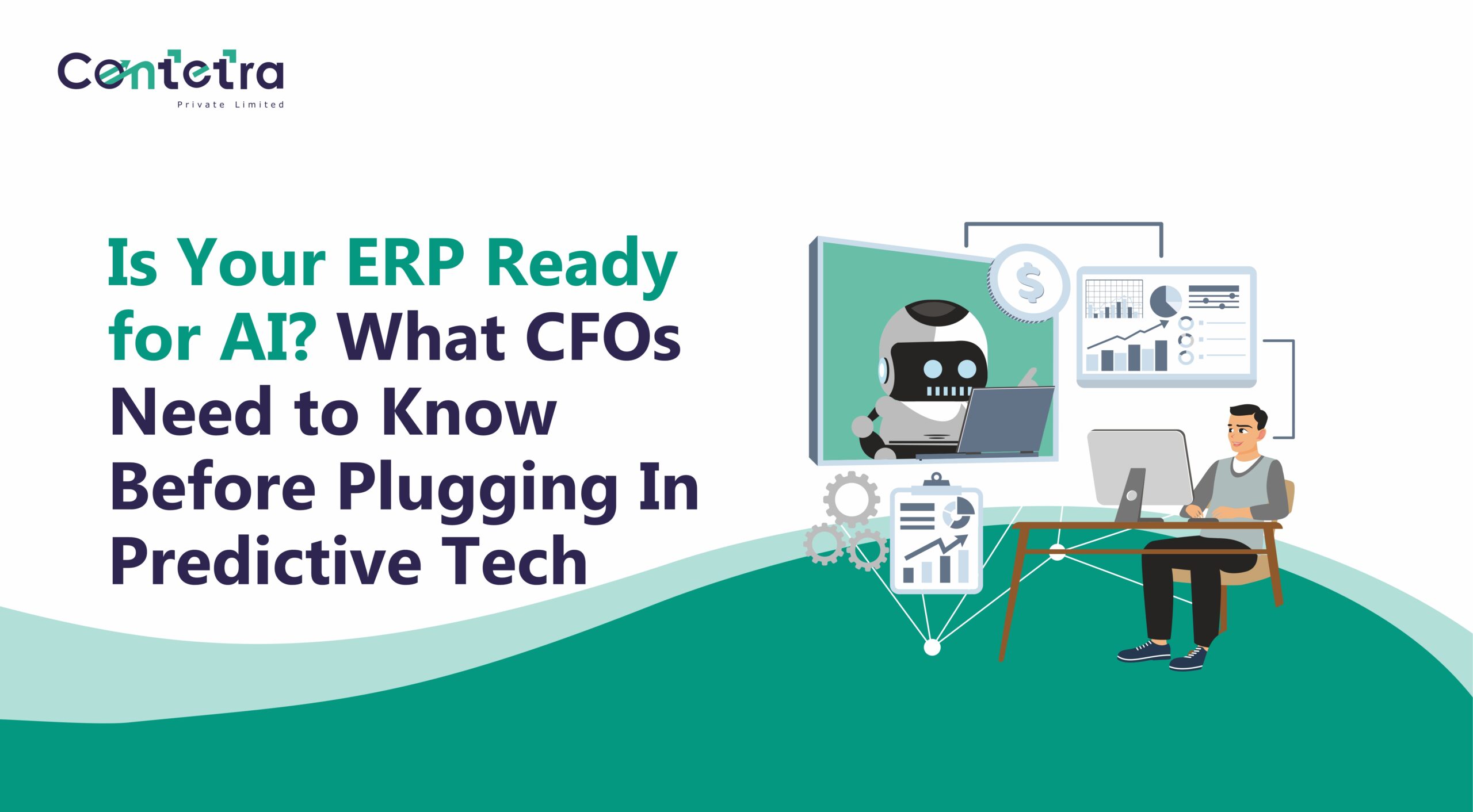
Before any organisation plugs predictive tech into their ERP, CFOs must ask a deeper, more strategic question:
“Is our ERP even mature enough to support intelligence?”
This is not a technical question.
It is a governance question, a leadership question, and a risk question.
This blog is written for CFOs who want to integrate AI responsibly without compromising accuracy, governance, or the financial backbone of their organisation. Many organisations begin this journey by exploring strong ERP backbones supported by erp consulting services in India.
1. AI Will Not Fix an Undisciplined ERP It Will Expose It
AI engines do not create intelligence; they derive it.
They learn from the patterns, signals, and data flowing into them.
So if your ERP environment is:
- full of duplicate masters
- inconsistent across plants or entities
- dependent on manual spreadsheets
- unreconciled at the subledger level
- driven by exceptions instead of discipline
- filled with inaccurate or missing fields
- suffering from outdated BOMs or routings
- controlled by people, not processes
AI will consume that disorder and output structured, attractive, elegant nonsense.
CFOs often assume AI will bring accuracy.
But the brutal truth is:
AI accelerates whatever exists order or disorder.
The danger is that AI presents wrong insights with supreme confidence.
And confident misinformation is far more dangerous than no information.
2. No AI Works Until ERP Data Stops Lying
ERP data can “look” correct and still be structurally unreliable.
AI does not judge the integrity of data it interprets the patterns within it.
Examples:
Poor Inventory Visibility → Wrong AI Recommendations
If your ERP shows stock because of delays in goods movement postings,
AI-driven reorder logic becomes catastrophic.
Bad Customer Master → Wrong Payment Predictions
If customer codes aren’t standardised, AI will misread behaviour patterns.
Incorrect Routings or Cycle Times → Faulty Production Forecasts
AI assumes your ERP timings reflect reality.
If not, your capacity planning will collapse.
Dirty Vendor Master → Wrong Cash Flow Signals
Inconsistent supplier identification corrupts payable predictions.
Poorly Maintained BOMs → Misleading Cost Predictions
AI will project the wrong cost curve and misguide pricing decisions.
AI is not the cure for data quality.
Data quality is the prerequisite for AI.
3. Before AI, CFOs Must Focus on ERP Maturity Not ERP Features
CFOs who succeed with AI start with a disciplined ERP backbone.
Not new modules. Not dashboards. Not AI pilots.
They invest in ERP maturity.
This is where many organisations lean on structured erp consulting solutions to ensure their foundation is stable before adding predictive layers.
Here are the pillars of maturity that determine whether AI will succeed or fail.
Pillar 1: Master Data Governance The Non-Negotiable
If ERP master data is weak, every AI project is doomed before it starts.
Ask yourself:
- Do we have duplicate SKUs?
- Are BOMs versioned and controlled?
- Are customer hierarchies valid and consistent?
- Do UOMs match across plants or warehouses?
- Are vendor masters standardised across units?
- Is location data accurate?
- Is product classification meaningful and not cosmetic?
Without master data discipline, predictive tech cannot interpret patterns correctly.
Master data is not an IT responsibility.
It is a finance governance weapon.
Pillar 2: Process Uniformity AI Cannot Interpret Chaos
An ERP with ten different ways to complete the same process cannot support intelligence.
AI needs:
- one purchase process
- one sales booking logic
- one costing framework
- one inventory valuation logic
- one pricing rulebook
- one production reporting standard
- one WIP capture methodology
If processes are improvised daily, AI becomes confused.
Predictive engines need consistency to identify patterns.
If users override workflows, bypass approvals, and post transactions directly in the GL, AI loses context.
AI cannot stabilise a process.
The process must stabilise before AI can learn from it.
Pillar 3: Reconciled, Real-Time Data AI Cannot Operate on Month-End Lag
AI predictions are only as fresh as the data.
If your ERP is updated only during month-end, your AI engine is predicting the past, not the future.
CFOs must ensure:
- real-time inventory bookings
- timely production postings
- daily sales synchronisations
- immediate goods movement entries
- daily AP/AR updates
- real-time cash and bank feeds
- reconciled subledgers
AI needs continuous signals
not compressed, month-end cleanups.
Pillar 4: Cross-System Integration AI Requires a Unified Business Spine
AI works only when ERP becomes the central intelligence backbone.
If your systems are scattered:
- CRM data in HubSpot
- production data in MES
- sales in spreadsheets
- finance in ERP
- marketing in Google Analytics
- procurement in emails
AI cannot produce a unified prediction.
Because your business is not providing a unified truth.
CFOs must mandate:
- structured data pipes
- API-based integration
- consistent mapping logic
- unified definitions
Without system integration, AI becomes 50% blind.
Pillar 5: Data Ownership & Governance AI Requires Discipline, Not Automation
This is where most companies fail.
AI adoption collapses when no one owns the truth.
CFOs must define:
- Who owns product masters?
- Who owns customer masters?
- Who approves changes?
- What is the change cadence?
- Who monitors exceptions?
- Who runs data hygiene audits?
- Who owns definitions across departments?
Accountability is the oxygen of AI.
Without governance, the ERP becomes a playground for overrides—
and AI becomes a liability.
4. The Smart CFO Doesn’t Start with AI They Start with a Test
CFOs must ask one powerful question:
“If AI predicts something today, can I trust the result?”
If the honest answer is no, you don’t have an AI readiness issue.
You have an ERP maturity issue.
The most successful CFOs begin their AI journey with a single high-value, low-risk predictive use case, such as:
- predictive cash flow alerts
- predictive inventory
- AI-driven exception detection
- automated anomaly flags
- predictive maintenance-informed costing
- gross margin risk signals
- dynamic pricing intelligence
One validated success leads to scaled adoption.
This is how mature finance teams roll out AI with discipline, not desperation.
The Leadership Takeaway
AI is not a strategy.
AI is an accelerant.
And accelerants only work when the foundation is stable.
A CFO ready for AI understands:
- AI doesn’t fix broken data.
It magnifies it. - AI doesn’t stabilise chaotic processes.
It exposes them. - AI doesn’t create a unified truth.
It requires one. - AI doesn’t replace governance.
It demands governance. - AI doesn’t work in silos.
It needs integrated business architecture.
The companies that win the AI decade will not be the ones who adopt AI first—
but the ones who prepare their ERP spine with discipline, truth, and data governance. With strong erp consulting services, organisations can build this backbone with confidence.
When your ERP is ready
AI won’t just improve decisions.
It will redefine how your organisation thinks, plans, executes, and grows.
And that transformation begins in the CFO’s office not in the IT department. Many leaders in India are already strengthening this journey through erp consulting solutions to ensure their systems are AI-ready.