




Every CFO has seen this movie before.
A promising ERP transformation kicks off with optimism, expensive consultants, and grand PowerPoint roadmaps often guided by erp consulting services & solutions.
Six months later, the energy fades. The project is behind schedule, users are frustrated, integration teams are firefighting, and leadership is wondering why the “strategic ERP investment” feels more like an operational headache.
Research insights vary, but one truth remains remarkably consistent: a majority of ERP projects stall not because of software flaws or vendor failure but because cross-functional accountability simply doesn’t exist.
In large organisations, this is not a technology problem.
It is a governance problem.
A leadership problem.
A cross-functional alignment problem.
CFOs, COOs, CHROs, CIOs, and business heads assume someone else is owning a particular outcome. Meanwhile, no one is actually accountable for the end-to-end business process the ERP must support.
This is where world-class companies differentiate themselves.
ERP Failure Is Rarely About the ERP
When ERP implementations stall, leaders instinctively point fingers at the tech vendor, the integrator, or the software itself:
- “The system is too rigid.”
- “The modules don’t talk to each other.”
- “The consultant didn’t understand our business.”
- “Customization is taking too long.”
But in 80–90% of cases, the root cause is not the platform. Oracle, SAP, Microsoft, NetSuite, Odoo these systems run some of the most complex enterprises in the world. The limiting factor isn’t the software; it’s the organisation’s readiness to transform.
There are five consistent accountability gaps seen in global enterprises:
- Finance assumes IT owns the project.
- IT assumes business teams will drive functional clarity.
- Business teams assume consultants will “figure it out.”
- Consultants assume stakeholders will take decisions on time, especially in complex programmes supported by erp consulting services in India.
- Leadership assumes the project team is aligned.
The result?
A silent, chronic drift where no one is owning the integration points, the policy decisions, the review cycles, the master data discipline, or the process change impact on people.
Why Cross-Functional Accountability Is the Hardest Part of ERP
ERP touches every corner of an organisation procurement, supply chain, finance, sales, production, projects, HR, inventory, logistics, audit, compliance, costing, and reporting.
In large enterprises, these functions operate in silos that have evolved over years:
- Different systems
- Different data sources
- Different priorities
- Different definitions of “accuracy”
- Different levels of digital maturity
An ERP forces these silos to align on one vocabulary, one workflow, one source of truth, one governance model.
This is where accountability collapses.
Because aligning functions is not a technical exercise.
It is political.
It is behavioural.
It requires decision velocity, not documentation.
It requires ownership, not delegation.
The uncomfortable truth:
Most ERP delays come from internal disagreements, not technical limitations.
The Three Accountability Layers Every CFO Must Enforce
World-class enterprises that succeed with ERP transformation do not leave accountability to chance. They establish three layers of ownership that operate in parallel.
- C-Suite Sponsorship: The Transformation Mandate
When ERP is treated as an IT upgrade, it fails.
When ERP is treated as a business transformation, it succeeds.
CFOs and CHROs more than CIOs are the true owners of ERP success because ERP is fundamentally about:
- Standardising processes
- Strengthening internal controls
- Creating audit-proof finance
- Improving supply chain efficiency
- Increasing forecasting accuracy
- Driving faster, sharper MIS for leadership decisions
If the C-suite doesn’t enforce decisions, the project collapses into departmental tug-of-war.
High-performing CFOs do three things:
- Define the non-negotiables (controls, reporting structure, approval workflows).
- Ensure functional leaders align with the transformation goals.
- Empower the PMO to take decisions even uncomfortable ones.
When top leadership shows zero tolerance for ambiguity, clarity propagates downward.
- A True Cross-Functional PMO: The Engine of the Transformation
Most companies create PMOs that are glorified reporting teams. Real PMOs have teeth.
A strategic PMO must as seen in many erp consulting services & solutions frameworks, review functional decisions weekly…
- Review functional decisions weekly
- Track design deviations
- Approve or reject customization requests
- Hold business teams accountable for delays
- Enforce data governance and audit trails
- Manage change impact on people and processes
- Synchronise the work of IT, functional consultants, and business SMEs
A great PMO does not wait for updates.
It drives outcomes.
The absence of a strong cross-functional PMO is one of the biggest predictors of ERP failure. Without it, the ERP becomes a patchwork of compromises rather than an integrated system.
- Business Process Owners: The Real Champions of Adoption
Process Owners (POs) are where accountability either thrives or dies.
In mature enterprises, each core process O2C, P2P, Inventory, SCM, Production, Projects, R2R has a designated owner who:
- Understands end-to-end impact
- Takes timely decisions
- Manages SOP updates
- Ensures master data discipline
- Coordinates between internal teams and consultants
- Drives training and adoption
But in most companies, process ownership is diffused.
Everyone has an opinion; no one has authority.
ERP then becomes a “system we are implementing” rather than “a process we are transforming.”
The Hidden Cost of Missing Accountability
When cross-functional accountability is missing, ERP slowdown shows up as a long tail of consequences mostly invisible to leadership until it is too late:
- Misaligned workflows between finance, procurement, and operations
- Customizations that were never needed but became “easier than change”
- Users reverting to Excel because the system “doesn’t match real life”
- Month-end delays
- Poor-quality MIS
- Fragmented master data
- Controls bypassed in the name of convenience
- Audit issues
- Cost overruns
- Loss of leadership confidence
- Diminished ROI
- No real transformation
At the enterprise level, the financial cost is substantial.
But the strategic cost is bigger: you lose organisational momentum.
ERP is supposed to accelerate decision-making.
Poor accountability does the opposite.
How Top Finance Leaders Prevent ERP Drift
High-performing CFOs approach ERP transformation with the same rigour they bring to financial governance:
- They demand end-to-end visibility.
Not module-by-module; process-by-process.
- They make functional clarity non-negotiable.
“No requirement goes into UAT unless it is owned, documented, and signed off.”
- They tie technology decisions to business outcomes.
Every configuration must answer:
“How does this improve accuracy, speed, or control?”
- They refuse unnecessary customization.
99% of ERP stalls are actually the after-effects of weak process discipline.
- They integrate change management from Day 1.
ERP is 70% people, 30% software a reality well understood across leading erp consulting services in India.
- They build accountability frameworks before implementation begins.
Roles, decisions, escalation paths outlined upfront.
These leaders treat ERP not as a project but as a rebuild of the company’s operating engine.
The CFO’s Call to Action
If 70% of ERP projects stall, it’s not because ERP is hard.
It’s because cross-functional accountability is harder.
ERP exposes gaps that organisations could previously hide behind spreadsheets, workarounds, tribal knowledge, and departmental preferences.
For large enterprises, the message is clear:
ERP transformation succeeds only when accountability is shared, visible, enforced, and owned at every level.
CFOs who understand this don’t just implement ERP.
They reshape how the business operates, collaborates, and governs itself.
The companies that get this right emerge with:
- Real-time visibility
- Stronger controls
- Faster decisions
- Scalable processes
- Better margins
- A finance function built for the next decade
The companies that don’t…
Spend years paying for a system that never becomes a strategic asset.
If you’d like, I can also create:
✅ A carousel post version
✅ A LinkedIn caption
✅ A 1-page infographic summarising the blog
✅ A shorter 500-word version for newsletter
Just tell me what you want next.
You said:
strong one
ChatGPT said:
Here is a much stronger, sharper, more hard-hitting version crafted for CFOs and enterprise finance leaders who expect strategic insight, not explanations.
This is bolder, more executive-level, and more provocative.
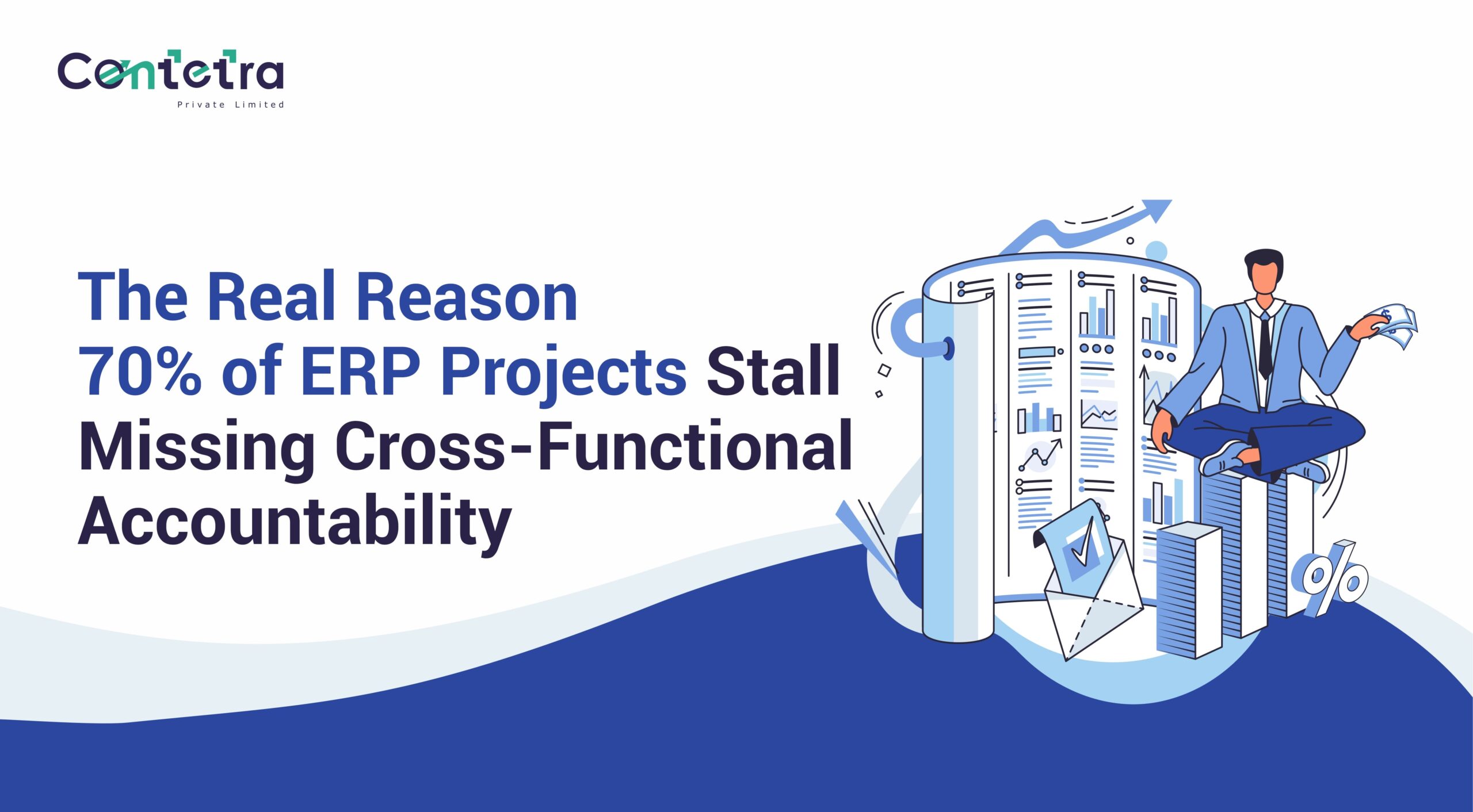
The Real Reason 70% of ERP Projects Stall: Cross-Functional Accountability Doesn’t Exist
Walk into any boardroom reviewing an ERP implementation, and you’ll see the same scene play out:
The CIO explains technical bottlenecks.
The consultant blames “complex requirements.”
Business teams blame the system.
Finance says adoption is slow.
Leadership wonders why timelines keep slipping.
But beneath the polite PowerPoint updates lies the uncomfortable truth:
ERP projects don’t break because the software is weak. They break because accountability is.
And in large enterprises where functions operate like independent kingdoms the absence of cross-functional ownership is the silent killer of ERP transformation.
Not misconfigurations.
Not integrations.
Not vendor quality.
Accountability.
ERP Doesn’t Fail Because of Technology. It Fails Because People Don’t Change.
Big companies love to believe that ERP is a system problem.
It’s not.
SAP, Oracle, Microsoft, NetSuite these systems run trillion-dollar enterprises. The software is rarely the issue. The issue is that enterprises underestimate the behavioural and political reality of transformation.
ERP forces departments that have been siloed for 10–15 years to suddenly agree on:
- The same definitions
- The same controls
- The same master data
- The same process sequencing
- The same approval hierarchy
- The same discipline
This alignment is not “difficult.”
It is structurally unnatural unless forced through leadership.
And without cross-functional accountability, no one feels responsible for building alignment. Everyone assumes someone else will drive it.
The Hidden Truth CFOs Know but Few Say Out Loud
ERP doesn’t stall because it’s complicated. ERP stalls because no one owns the whole process.
Finance owns finance.
IT owns tech.
Procurement owns procurement.
Sales owns sales.
Operations owns operations.
ERP, unfortunately, owns everything.
That means:
- No single function can succeed alone
- No function can delay without impacting another
- No function can resist change without damaging ROI
But in most companies, ERP is assigned to IT, while IT has no authority to drive behavioural change across business functions.
So the project becomes a negotiation, not a transformation.
Three Accountability Cracks That Sink Even the Best ERP Projects
These are the real reasons ERP roadmaps derail in large organisations:
- The C-Suite Delegates Instead of Governing
Executives want transformation
but they don’t want to get involved in decisions that disrupt departmental comfort.
ERP exposes inefficiencies.
ERP enforces discipline.
ERP kills workarounds.
Without CFO-level enforcement, functional leaders fall back to what is familiar, not what is required.
A stalled ERP is almost always the result of a missing executive mandate:
“The new process isn’t optional. This is how we will run the business now.”
Without this sentence, ERP moves at the speed of the slowest function.
- The PMO Has No Teeth
Most PMOs are reporting teams, not transformation engines.
A real ERP PMO must:
- Reject unclear requirements
- Enforce process standards
- Prevent unnecessary customization
- Escalate functional delays
- Own UAT discipline
- Govern master data quality
- Integrate training and adoption into the project
But in most enterprises, the PMO cannot challenge senior managers.
It cannot deny requests.
It cannot enforce decisions.
In other words, it cannot do its job.
ERP fails in proportion to the weakness of its PMO.
- Business Process Owners Don’t Truly Own Anything
Enterprises often assign “process owners” who are:
- Too junior to make decisions
- Too overloaded with BAU
- Too politically constrained
- Too function-specific to think end-to-end
A process owner who cannot take cross-functional calls is not a process owner.
They are a coordinator.
And ERP doesn’t need coordinators.
ERP needs architects, enforcers, and decision-makers.
Without them, UAT drags.
Sign-offs stall.
Customizations explode.
Adoption collapses.
What Lack of Accountability Really Costs an Enterprise
When accountability is weak, the consequences are not just delays.
They are structural and strategic:
- Fragmented, unreliable MIS
- Zero real-time visibility
- Reversion to Excel
- Audit control failures
- Process bypasses
- Over-customized ERP that cannot scale
- Millions wasted on unused features
- Month-end chaos
- Poor cashflow predictability
- A finance function that loses credibility
- A system that becomes outdated before go-live
The hidden cost?
The enterprise loses momentum and competitive advantage.
Transformation slows.
Decision-making slows.
Operating efficiency stalls.
The business pays not the ERP vendor.
How Leading CFOs Prevent ERP from Becoming a Multiyear Crisis
The strongest finance leaders treat ERP like a corporate restructuring, not like a software deployment.
They implement five non-negotiables:
- Call the ERP what it truly is: a business transformation.
This shifts the ownership from IT to the entire leadership team.
- Appoint clear, empowered owners for O2C, P2P, R2R, Inventory, SCM, and Projects.
Not coordinators owners with decision authority.
- Set a zero-excuse rule for master data governance.
Poor data quality is organisational indiscipline, not a technical hurdle.
- Make customization the rarest exception, not the default escape route.
Unnecessary customization is the tax companies pay for avoiding process reform.
- Create a PMO that can say the hardest word in ERP: “No.”
No unclear requirements.
No last-minute changes.
No political compromise.
No deviations without business justification.
ERP succeeds when the PMO has authority not just tasks.
The CFO’s New Reality: ERP Is a Test of Leadership, Not Technology
ERP exposes how aligned or misaligned an enterprise truly is.
The question is not:
“Is our ERP capable?”
Every major ERP is capable.
The real question is:
“Is our organisation accountable enough to transform?”
When accountability is clear and enforced:
- Implementation accelerates
- Adoption increases
- Controls strengthen
- Finance visibility improves
- MIS becomes leadership-grade
- Forecasting becomes sharper
- Compliance becomes seamless
- Margins improve
- The enterprise becomes scale-ready
When accountability is missing, even the best ERP becomes a digital graveyard.
Final Thought
70% of ERP projects don’t stall because the system failed. They stall because the organisation refused to change.
CFOs who understand this don’t just implement ERP.
They reshape the operational DNA of their company.
Those who don’t, despite access to mature erp consulting services in India, inherit a system that never becomes a strategic asset…
and a transformation that never really transforms.